Archive for the 'English' Category

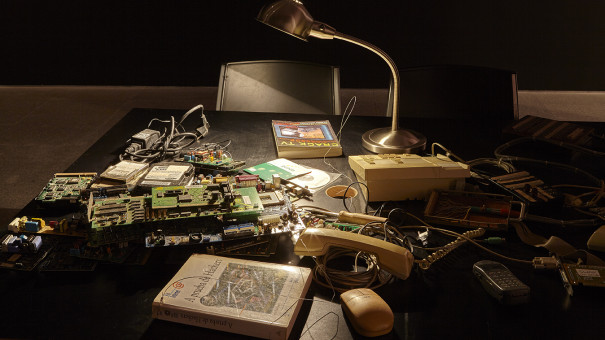
{press} 404 project Seoul 2007

International Symposium and

regarding data/media art preservation, presentation and archiving

Object Not Found_ Seoul2007”

October 22 - 26 @ of Contemporary Art

“In memory of the heroic boys and girls that worked deep into the night for all those months, in those small and hot offices at CERN, Rom is preserved as a ‘place on the web.’ None of the other rooms are still used for the Web. Room is the only and true monument to the beginning of the Web, a tribute to a place in the past, where the future was shaped.”
© -2003 Room . All rights reserved.

When internet is introduced to daily life, people excited about this totally different world form our physical space. It makes blur the geographical distance and time zone. When people access to the internet, they will see limitless-like space. Just like this, web is considered as the space which is very of the secured, the safe and most of all, the free. Even it seems to be very much equal space for everybody. However, unlikely our expectation, Web is the still very fragile and tentative space. Unfortunately people do not take this as the serious issue. Read the rest of this entry »

Tags: , , , ,

Related posts

Share:
  • Print this article!
  • E-mail this story to a friend!
  • Meneame
  • BlogMemes Sp
  • Google
  • Technorati
  • del.icio.us
  • Facebook
  • YahooMyWeb
  • BarraPunto

The Database Imaginary: Memory_Archive_Database v 4.0

Steve Dietz
in Aesthetics
edited by Victoria Vesna

In 1968, in a report to the Rockefeller Foundation during a residency at SUNY Stony Brook, Nam June Paik argued that 97 percent of all electronic music was not recorded and that “a simple measure would solve the whole problem. An information center for unpublished electronic media should be created.”1 At the time, this meant such a center would “provide a Xerox copy and a tape copy of musical pieces, at the request of performers, students, and organizers from all over the world.” Convert analog to digital, and the dream lives on, perhaps more vibrant than ever, of a universal , with access to everything by anyone anywhere at any time. Read the rest of this entry »

Tags: , , ,

Related posts

Share:
  • Print this article!
  • E-mail this story to a friend!
  • Meneame
  • BlogMemes Sp
  • Google
  • Technorati
  • del.icio.us
  • Facebook
  • YahooMyWeb
  • BarraPunto

Free Software on the Surface, Behind the Screen and in a Cultural Kaleidoscope: X-Devian.

akb x-devianThe New ® System

By

In 1999, when the art and technology festival Ars Electronica awarded The Golden Nica, first prize in the ”.net” category, to the programmer Linus Torvalds for his development of the Linux , it was pointing in general to the relationship between and art, and more specifically to the affinity between and that part of contemporary art which is concerned with software’s constantly increasing influence on social, economic and political conditions. Like Linux, this part of contemporary art works against the proprietary software industry’s standardization, repression and rationalization of the software culture, and instead explores alternate possibilities for freeing the software culture through more open, expressive and speculative processes.
On a more indirect level, Ars Electronica’s choice of Linux also emphasized another relationship between and this contemporary art, i.e. the idea informing both that software is not just a question of programming, but of producing culture - of understanding and using technology as a means of engaging in a social context. According to the founder of the Foundation (FSF) Richard Stallman, is about ”practical material advantages” but also about ”what kind of society we want to live in, and what constitutes a good society”. 1 Stallman himself imagines an extremely collective and creative society founded on the freedom to ”use, study, copy, modify and redistribute software”. For him, the ’s fundamental abolishment of rights represents a chance to structurally and conceptually ”reprogram” society for the better, and this is an opinion he shares with much of contemporary art. Read the rest of this entry »

Tags: , , , , , , , , , , , , , ,

Related posts

Share:
  • Print this article!
  • E-mail this story to a friend!
  • Meneame
  • BlogMemes Sp
  • Google
  • Technorati
  • del.icio.us
  • Facebook
  • YahooMyWeb
  • BarraPunto

The Aesthetic Interface

May
9-11 May Conference
11-13 May Exhibition, Workshops
Locations: IT-Huset, IT-Parken, Universitet & Kunstbygning, Denmark

Information about here.

Map of IT-Parken/IT-City here (the conference takes place in building 5510)

Conference poster

Advance programme (short version)

Advance programme (long version with abstracts and bios)

The interface is the primary cultural form of the digital age. Here the invisible technological dimensions of the computer are given form in order to meet human perception and agency. This encounter is enacted through aesthetic forms stemming not only from the functional domains and tools, but increasingly also from aesthetic traditions, the old media and from the new media aesthetics. This interplay takes place both in software interfaces, where aesthetic and cultural perspectives are gaining ground, in the digital arts and in our general technological culture – keywords range from experience oriented design and creative software to software studies, software art, new media, digital arts, techno culture and digital activism. Read the rest of this entry »

Tags: , ,

Related posts

Share:
  • Print this article!
  • E-mail this story to a friend!
  • Meneame
  • BlogMemes Sp
  • Google
  • Technorati
  • del.icio.us
  • Facebook
  • YahooMyWeb
  • BarraPunto

Who talks about art today?

documenta 12 magazines, Zehar

Who talks about art today?-Daniel García Andujar

When we considered organising a debate on the teaching of art, on the one hand we wanted to include the “educational memory” built up at Arteleku which, like a “rolling stone”, seemed to us to be “alive” and, on the other, we wished to open up a discussion on the current teaching of art (music, architecture, and so on), based on the comments and accounts of people with experience in official and non-official who have worked together with Arteleku and/or .

By taking an analysis of the various and experiences that we have been familiar with as a starting point and, as we are aware of how important is becoming in modern societies, we decided to issue a call for contributions and raise a series of questions that would help us to discover and disseminate the ideas that the agents involved in teaching art are working on: Read the rest of this entry »

Tags: , , , , , ,

Related posts

Share:
  • Print this article!
  • E-mail this story to a friend!
  • Meneame
  • BlogMemes Sp
  • Google
  • Technorati
  • del.icio.us
  • Facebook
  • YahooMyWeb
  • BarraPunto

Art’s price

Toma las riendas

By Daniel G. Andujar*

Artists Rights

, winter

In the last few years, has become a controversial issue. On the one hand, current information and communication technologies have generated a new social reality in which both old situations and new sceneries coexist. Undoubtedly, these transformations have also produced a crisis on the prevailing systems of and cultural management. Societies have enough mechanisms to adapt themselves to their own processes, but we must ask ourselves if the current dogmatic legislative apparatus is prepared to confront these changes. On the other hand, the recent pressure that collective management societies have exerted on our legislators, so as to make sure that the new laws on will safekeep their interests, has intensified this debate. Specialists express their opinions on this subject even on the paparazzi TV shows, and of course, a few of them may suddenly show their preference for one of the options with the sole purpose of taking advantage of this situation. This is not just one more ephemeral topic. It’s in fact an open confrontation between those who and defend leisure industries -culture’s big business-, and those who demand an urgent revision of the prevailing system and a reformulation of the notion of in a new “” context. Read the rest of this entry »

Tags: , , , , , , , , ,

Related posts

Share:
  • Print this article!
  • E-mail this story to a friend!
  • Meneame
  • BlogMemes Sp
  • Google
  • Technorati
  • del.icio.us
  • Facebook
  • YahooMyWeb
  • BarraPunto

404 Object not found: Symposium

Object not found Symposium

@
1. Date: Oct. 20, (Fri) 13:00

2. Venue: http://www.404objectnotfound.net Read the rest of this entry »

Tags: , , , ,

Related posts

Share:
  • Print this article!
  • E-mail this story to a friend!
  • Meneame
  • BlogMemes Sp
  • Google
  • Technorati
  • del.icio.us
  • Facebook
  • YahooMyWeb
  • BarraPunto

Armed citizen

Armed citizen

Presented in the exhibition as an upgrade of almost 100 images, the internet project shows a series of 17 small arms. No information is given on their origins. Who owns them? Are they being used as criminal evidence? Are they perhaps murder weapons? Who does the ›‹ of the title refer to — the police? Or a citizens’ defence group that has taken up arms? Is there some allusion to the liberal firearms laws in the United States, to bloody incidents like the amok shootings that took place in Columbine High School, Colorado, in 1999, or in the Gutenberg Gymnasium in Erfurt in 2002? is difficult to pin down. But it is safe to assert that it deals with an indeterminate feeling of fear and menace, and, by association, with the growing longing for security in a world felt to be increasingly less safe. The exhibition deliberately groups in a kind of »security zone« together with Heath Bunting’s CCTV and Rachel Baker and Heath Bunting’s CCTV Sabotag — further irational works pointing to the essential futility of technology — or weapons based protective measures. (Inke Arns)

Tags: , , , , , , , , , , , , ,

Related posts

Share:
  • Print this article!
  • E-mail this story to a friend!
  • Meneame
  • BlogMemes Sp
  • Google
  • Technorati
  • del.icio.us
  • Facebook
  • YahooMyWeb
  • BarraPunto

Language (property)

Language (property)

Daniel García Andújar – the Spanish media artist better known by his company name — almost ten years ago created with Language (property) a work addressing the increasing privatization and commodification of language. A plain HTML page presents a list of sentences that have become registered trademarks and thus the property of their corporate owners. Examples include »Where do you want to go today?™« (Microsoft), »A better return on information ™« (SAP), »Moving at the speed of business™« (UPS), »What you never thought possible™« (Motorola). By giving his project the title Remember, language is not free™, Andújar anticipated the disputes surrounding ›‹ in the following years (and increasingly evident in the second half of the 1990s with the ruthless scramble for domain names in the World Wide Web). While on the website the individual sentences are linked to the notices of the relevant companies, a large-format, almost ›immersive‹, wall Presented has been chosen for the exhibition.(Inke Arns)

Tags: , , , , , , , , , ,

Related posts

Share:
  • Print this article!
  • E-mail this story to a friend!
  • Meneame
  • BlogMemes Sp
  • Google
  • Technorati
  • del.icio.us
  • Facebook
  • YahooMyWeb
  • BarraPunto

Postcapital

 by Raquel Herrera Ferrer

For someone who was “born” in terms of cultural awareness long after The Wall fell (I still remember when the pop music magazine I used to read would distribute a “free piece of the wall” with an “authenticity certificate” among its readers), the feeling of visiting exhibition, a physical and virtual project hosted by Palau de (Barcelona, Spain) between April 12th and September 25th, is that of a Natural History Museum.

The concept has been developed by essayist and curator to talk about the ensemble of phenomena regarding life after Communism and the decay of leftist ideologies that gave way to the omnipresence of Capitalism and its subsequent ravages.

Read the rest of this entry »

Tags: , , , ,

Related posts

Share:
  • Print this article!
  • E-mail this story to a friend!
  • Meneame
  • BlogMemes Sp
  • Google
  • Technorati
  • del.icio.us
  • Facebook
  • YahooMyWeb
  • BarraPunto