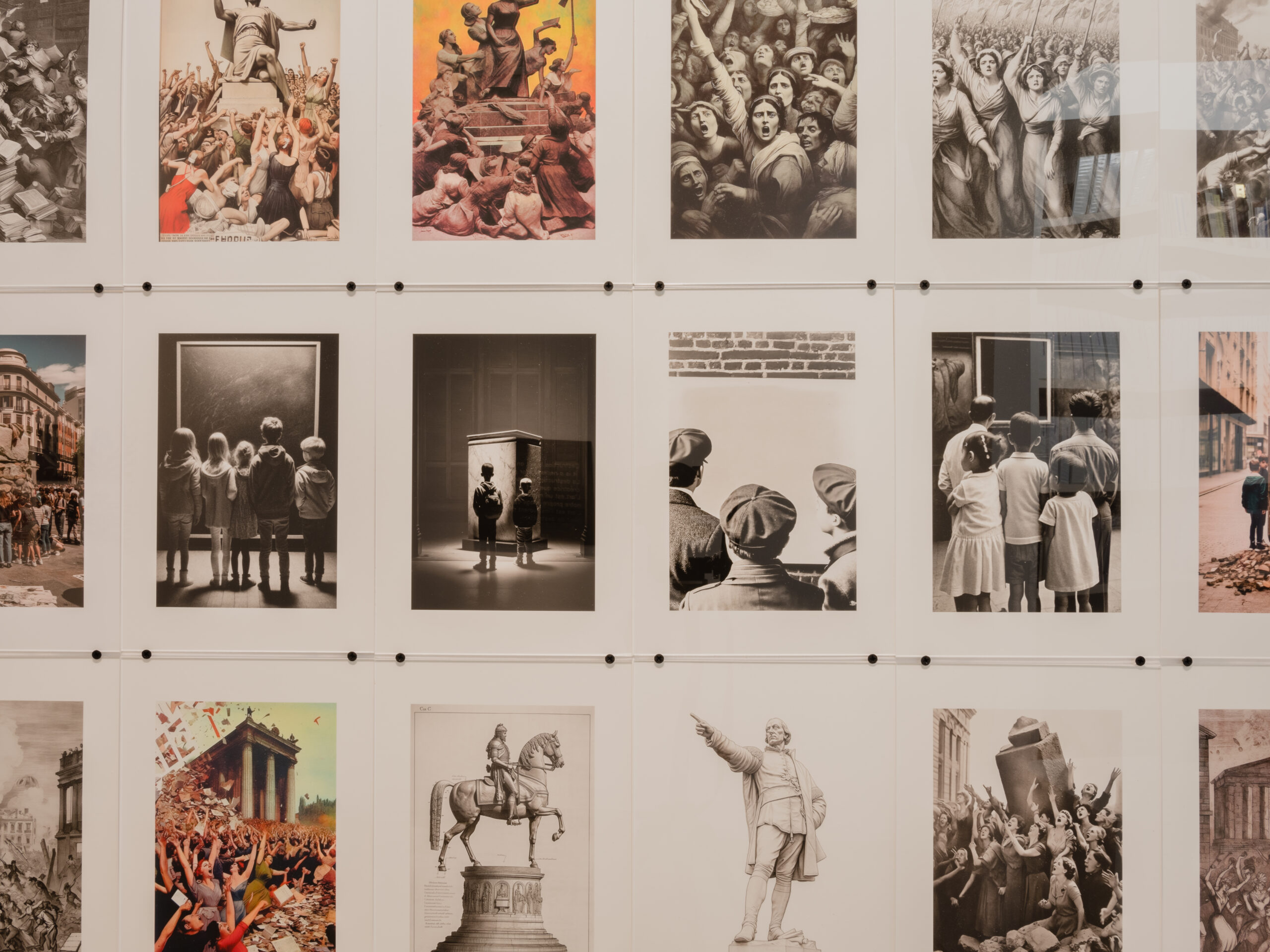
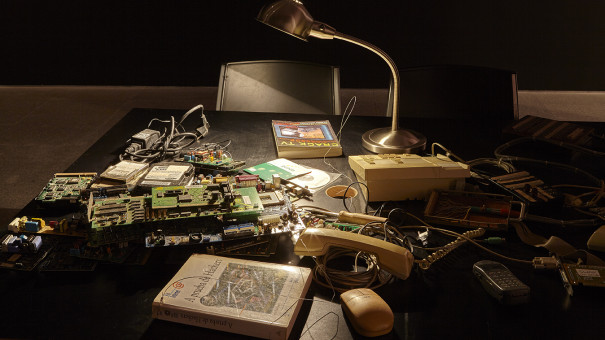
Daniel García Andújar en IED Máster – Observatorio Cultural 2010 from IED Madrid on Vimeo.

El artista multimedia y teórico del arte García Andújar impartió la conferencia “Estructuras de la imagen, hurgando el código” en el , dentro del Observatorio Cultural, un espacio creado por el Master of European Design Labs para examinar las derivas contemporáneas del mundo de la creación. García Andújar (Almoradí, 1966) centra su trabajo en los campos del videoarte y el net.art, siendo uno de los creadores más críticos e irónicos del panorama artístico actual. Sus piezas son una invitación a reflexionar sobre el uso actual de los medios tecnológicos y de comunicación para desmontar el sistema de jerarquía dominante en éstos mediante la libre circulación de información, redes de cooperación y nuevos conceptos como el hacktivismo.

www.iedmadrid.com


Sobre

y el Centro de Investigación Biomédica de Barcelona inician un proceso de exploración sobre procesos de investigación (artística y científica), basándose en las dinámicas de los colaboratorios. Generando herramientas de investigación cruzada, Grid_Spinoza se extiende entre dos ámbitos sin respetar los compartimentos estancos que el desarrollo profesional tiende a construir.

Daniel G. Andújar . Nos citamos con el artista Daniel G. Andújar (Almoradí, 1966) en Hangar. Continue reading »


NOUS CREADORS

Artistes amb noves mirades, noves maneres d’entendre el món

Anem a l’estudi de Daniel G. Andújar, un dels artistes espanyols amb una trajectòria internacional molt important. Pioner en l’ús d’internet i les noves tecnologies com a eines de creació. Andújar fa pocs dies exposava al , el museu d’art contemporarni de girona, part del seu arxiu postcapitalista. Una reflexió sobre la cultura de l’arxiu en què vivim des de l’irrupció de la tecnologia.


Público/Públic Perfil

Lucia Lijtmaer, dijous 19 d’agost deL 2010

12 ( 01 ) (PUBLICO – CAT 19082010) FOTOS BAJA – PUBLI BAJA

L’artista Daniel García Andújar analitza els efectes de la digitalització en la manera de percebre la realitat

L’artista Daniel García Andújar em cita al seu estudi, un espai diàfan, clar i tranquil al carrer Bergara, on es respira producció per totes les cantonades. Un parell de col·laboradors treballen en silenci mentre García Andújar em mostra fullets i llibres dels seus últims projectes. Bremen, Seül, Noruega i el pavelló català de la Biennal de Venècia figuren en el seu impressionant currículum només de l’últim any.

L’últim treball de García Andújar, Objetos de deseo, presentat a l’exposició col·lectiva -València-Palma, ha tingut molta repercussió. L’artista mostra, entre altres peces, un palauet-maqueta de la casa de Fèlix Millet fet amb bitllets de 100 i 500 euros, o l’escombreta del vàter del palauet de Jaume Matas. “Mai saps quin serà el nivell d’interpretació de la gent, perquè l’art sembla con- tenir un llenguatge molt específic de l’obra”, diu, una mica sorprès davant la reacció de la premsa. “En el fons es tracta d’una reflexió entorn a la vida i a la riquesa. La meva intenció era retratar com Espanya va passar a formar part d’un club de nous rics i com un clan de corruptes roba per coses molt superficials, la qual cosa és gairebé còmica”, apunta. Continue reading »


ZPŮSOBY TVORBY

Daniel G. Andújar -Iris Dressler

Umělec 1/2010 / cz en de

: V jednom ze svých posledních rozhovorů jste popsal, jak praxe velkých uměleckých institucí odcizuje autora jeho dílu. Samotný umělec, který přijede do galerie instalovat své práce, je poslán do luxusního hotelu, zatímco armáda profesionálů se stará o to, aby jeho dílo bylo „správně“ prezentováno. Tou dobou jsou již kurátor a vzdělávací a PR oddělení dávno domluveni, jak bude umělcovo dílo zprostředkováno veřejnosti. Když tedy umělec nakonec přijde na výstavu, své dílo nepoznává.
Daniel G. Andújar: Kulturní průmysl opustil uměleckou produkci i vytváření nových obsahů již před desítkami let. Umělci byli zatlačeni do pozadí, aby ustoupili nové elitě kulturních manažerů pořádajících bienále ve věžích ze slonoviny, pojímajících je jako mausolea.
V kulturním průmyslu, který zaměstnává stále více a více lidí, jsou umělci umístěni až na nejnižším stupni ekonomické aktivity. Mnoho lidí se v našem světě slušně uživí, ale umělci „riskují své životy“. Může tento systém umění přežít bez současných umělců? Zdálo by se, že mnoho institucí bez nich přežít může.
Umění, stejně jako jakýkoli kulturní proces, je především procesem předávání a přenosu, nepřetržitý, trvalý a nezbytný dialog. Nesmíme však zapomínat, že umění je také překračováním pravidel, roztržkou, ironií, parodií, přivlastňováním si, zpronevěřováním, konfrontací, pátráním, objevováním, tázáním se a konfliktem. Umění může a musí hledat nová území a rozvíjet v nich nové myšlenky. A pokud neexistují, musíme se pokusit je vytvořit.
Umělecká praxe musí být proměněna ve vzdor proti stále globalizovanějšímu, hierarchizovanějšímu, rozptýlenějšímu a standardizovanějšímu světu. Umělecká praxe musí odhalit rozložení moci a vytvořit mechanismy, které mohou zaručit její dlouhodobý vliv a rozšířit daný diskurz i za hranice světa milovníků umění a uměleckých institucí. Continue reading »


ARTECONTEXTO+N25

Con el título La exposición: nuevas prácticas, viejos contenedores el dossier de nuestro primer número del año reflexiona –a través de las firmas de José Manuel Costa, Christiane Paul, Juan Antonio Álvarez Reyes y Mónica Núñez Luis– sobre las exigencias de las nuevas formulaciones artísticas y su difícil encaje en modelos expositivos y estructuras museales que se sustentan en esquemas tradicionales tanto en lo funcional como en lo ideológico, más allá de que su arquitectura adopte fórmulas novedosas. Mientras, Daniel G. Andújar, en una entrevista con Alicia Murría, analiza el panorama que han abierto las tecnologías señalando la responsabilidad del artista ante estos cambios. Continue reading »


Corversation

The Unavowable Community

: In one of our recent conversations, you described how the machinery of the bigger art institutions alienates the artists from their work to a certain extent. You put it more or less in the following way: the artist, arriving at the museum to install his or her works, is sent to luxury hotels, restaurants and bars, while an armada of professionals—technicians, restorers, architects, designers, coordinators, assistants and so forth—care for the ‘proper’ presentation and communication of his of her work, following the standards of the respective institution. This is not to mention that at this moment the curator and the PR and education departments have long since defined—again in line with the conventions of the respective house—the ways of mediating the artist’s works. The artist, finally arriving at the ‘ready-to-go’ exhibition, might be shocked, as he or she no longer recognises his or her work the way it is embodied in and absorbed by the corporate setting. But it is too late: the press, board, VIPs and the like are already standing by. These attitudes and workflows of the institutional machinery are of course not a new phenomenon if you just remember the cartoon-like diagram Average Day at the Museum by the MoMA from the 1940s. But it seems that until now museums in particular are largely ignoring over 40 years of ongoing and quite diverse practices as well as discourses of institutional critique. They instead basically submit themselves far too voluntarily to almost phantasmal political pressures regarding the museum’s city marketing and tourist impact, fixating on irrational growth in visitor numbers and pulling in lucrative and glamorous private corporations. In my view, these politically indoctrinated ‘missions’ of the museum (which go hand in hand with corporate demands) have nothing to do—as is often claimed—with the financial needs of museum maintenance. They are solely about putting the museum on a prestigious stage for business and politics. By this logic, the artist seems to be a sort of alien, a disruptive factor that needs to be sedated to fit in with the museum’s rhetoric.

Daniel G. Andújar: Artistic practice, as I conceive it, must be transformed into a form of ‘resistance’ against a model obstinately aimed at prevailing in a space of relations that is becoming more and more confused, normalised, globalised, hierarchical, diffused, standardised and so on. Our society, economy and culture are founded upon interests, values, institutions, and systems of representation that, in general terms, limit creativity, confiscate and manipulate the artist’s work and divert his energy toward sterile confrontation and discouragement. Continue reading »


The following is another way of presenting a few of the issues that this project wishes to analyse. It is a virtual dialogue-in-progress between and Daniel G. Andújar, written in the places and moments when it was possible to do so. Many of the ideas that were developed, however, were expressed when G. Andújar was in Valencia carrying out a workshop together with Rogelio López Cuenca. Themes such as the social commitment of contemporary artists, their roles within the socio-cultural and socio-political framework, the real possibilities and tactics of survival and the creation of new ways of understanding their trade in a society undergoing continual change, are side by side with elements which come from the very title of the project: What tools do artists today have at their disposal? Where or against what should the rereadings resulting from their actions be addressed?

Álvaro de los Ángeles
: The theoretical-practical workshop-encounter that you and Rogelio led from 3rd through 5th March 2008 served to define several of the central themes of the project Herramientas del arte. Relecturas [Tools of Art. Rereadings]. It’s true that not all of the concepts on the programme were able to be developed, in part because the entire process was condensed in three days, but, due to some of the aspects that were discussed there and the debate these created, the general impression after the workshop was that many questions were raised and new ways of facing the artistic experience emerged.
From the very beginning, this project was planned to raise questions, to examine supposedly unquestionable facets of culture and its institutions, for all of the agents involved to consider which channels the artistic practices of today can be directed and to stir up a debate about the artist’s place in society. Also, if anything characterises art today, it is the hybridisation of techniques, media, the ways of exhibiting it and its relationship with other social subjects, such as politics, sociology, history, philosophy, psychoanalysis, architecture, or city planning… To which we could add other subjects, those not qualified as “scientific” but theorisable nonetheless, such as the question of memory, the archive as a model of contemporary society, the new interconnected social networks, the associationism and activism oriented towards art, or projected and created from it.
Can the concept of art’s functionality, its usefulness within society (as it has been conceived since at least the 1930s and then its evolution in later decades) have a correlate in the contemporary art of today? Is a rereading of its functions and usefulness possible from the basis of the elements created by contemporary tools, especially those which have derived or emerged from technology? Is this the only way of re-reading its practice? And, as a consequence, in a society governed by macro-economics, where everything is valued in real time or even in advance, can art still have a real social function, in the feasible, palpable sense?

Daniel G. Andújar: The practice of art, as I understand it, must also become a show of “resistance,” a model that obstinately wants to remain in a space of relationships which are more and more hierarchical, diffused, globalised, standardised… Those who direct the framework of cultural industries and the management of cultural institutions abandoned, decades ago, the processes of creating new contents and cultural production as a collective construction. Most of the professionals who run this framework are simply developing a personal power structure, climbing up the ladder to the most visible and media-friendly part of the public and private art institutions. They flaunt their power and reign over the reality of their little empire. The Art Institution has been absorbed as just another mechanism in the process of service production. It is an active part of the touristisation process in the urban context and participates in the complex re-adaptation of the new city’s infrastructures. Artists have been pushed out of the court to make way for a new elite of cultural managers who work in ivory towers, conceived more like mausoleums, on biennial events. Continue reading »


papers d’art
a Daniel García Andújar

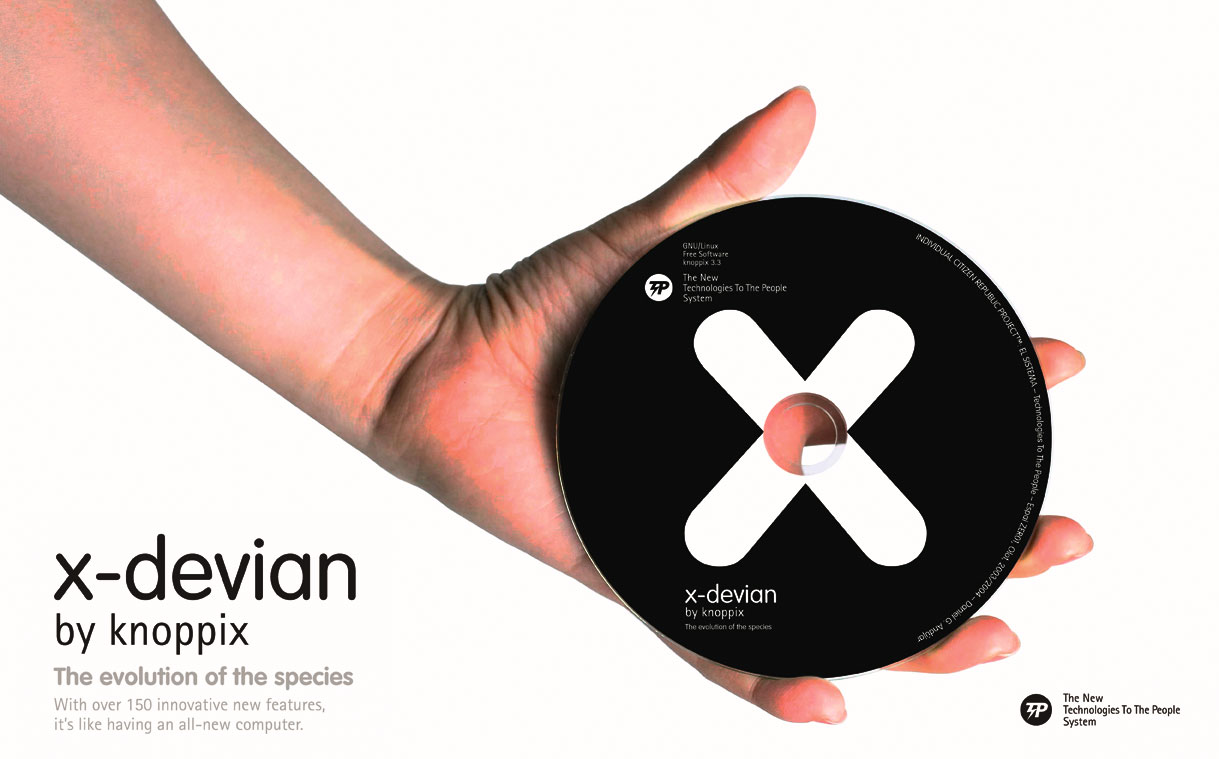
El 1996 crees Thecnologies to The People, una mena de corporació fictícia per publicitar tot tipus de serveis i productes vinculats a Internet d’accés lliure. Com va sorgir la creació d’aquesta corporació, a quins objectius responia?
Thecnologies to The People és una empresa virtual que jo utilitzo com a referent, com a cobertura paral·lela a allò que és i representa el món de l’art a fi de parlar de certs temes que en cada moment poden ser recurrents, per referir-me a la corporació com a sistema de gestió i representació molt més sofisticat que els que habitualment es desenvolupen en el món de l’art o en el mateix espai del museu.

Thecnologies to The People es crea l’any 1996 a Alemanya a partir d’un seguit de reflexions sobre el que estava passant en aquell moment arran de les transformacions derivades de l’ús de les noves tecnologies. A mitjan dels anys noranta es va produir una mena d’explosió del món de la tecnologia, del món d’Internet. Era el moment en què Internet irromp com una xarxa d’ús domèstic a través del navegador pla, quan comencen a proliferar les línies particulars i la gent comença a utilitzar de forma molt més evident serveis com el correu electrònic. També és veritat que en aquell moment hi havia un excessiu protagonisme, una confiança excessiva. S’estava creant un espectre, una visió del món que havia de canviar de manera absoluta les noves tecnologies de la informació i la comunicació. Nosaltres, a Thecnologies to The People, no creiem que aquell panorama seria tal com es dibuixava en aquell moment. Es parlava d’un accés més democràtic als mitjans, d’un major grau d’independència de l’individu com a tal, davant les institucions o l’estat i, sobretot, una transmissió i un accés a una informació ingent. Tot això, aquell moment, era una situació absolutament nova. Molta gent, també els mitjans, van tractar de dibuixar el panorama dient que allò portaria més llibertat i que proporcionaria un major grau de democràcia o desenvolupament a determinats països. Continue reading »